
Washington DOC Inmate Population
The official state agency is the Washington State Department of Corrections (DOC). Its organization page ties the agency's work to RCW 72.09.010 and describes a corrections system for people convicted under Washington law. That matters for search. A person booked into jail yesterday will usually be in a county or city jail roster, while a person sentenced to state custody belongs in the DOC inmate population and should be checked through the DOC inmate locator.
The DOC inmate population includes people in prison, reentry, and other DOC incarcerated locations. DOC's prison facilities page reported 14,137 incarcerated individuals by age as of 12/31/2025, with a note that the count includes all incarcerated-individual locations such as prison, reentry, and out-of-state. A narrower DOC January 2026 average daily population report listed 13,050 as the Prison Facility Totals ADP and 13,999 for prison total confinement plus partial confinement.
The DOC home page is the agency's main entry point for records, incarcerated search, warrant search, facilities, publications, and public records.
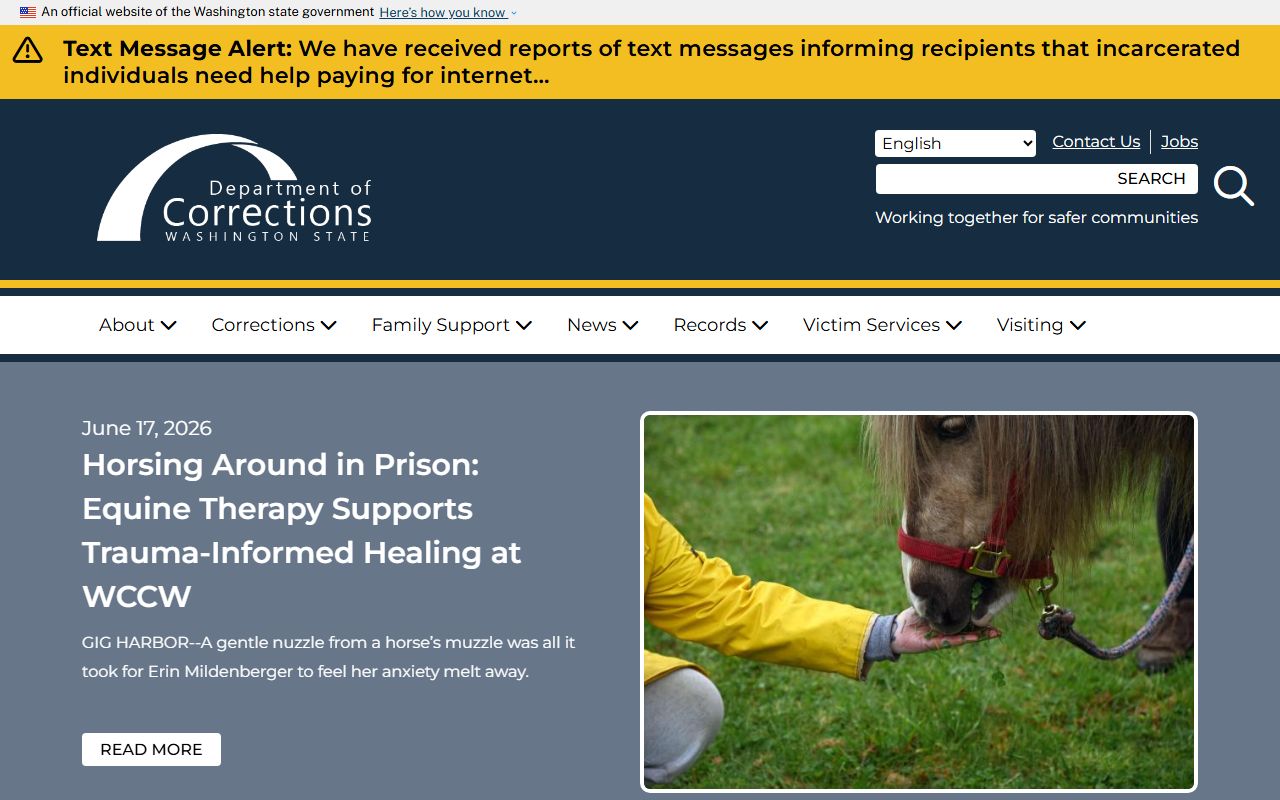
That statewide starting point is useful when a jail roster no longer shows a person because the case has moved from local booking to state prison custody.
DOC Inmate Search Fields
The official DOC Incarcerated Search is the state prison locator for Washington. The visible search fields are DOC Number, First Name, and Last Name. DOC says users may enter a DOC number or a name, and the agency warns that special characters other than hyphens and apostrophes cannot be used. A DOC number is not a county booking number, BOP register number, ICE A-number, or court cause number.
The best DOC inmate population search starts with the DOC number when it is known. Name searches can work, but spelling differences and transfer timing can lead to missed results. DOC's search-resources page says selected public information can include the incarcerated person's name, DOC number, and current facility. If a person does not appear in DOC search, check whether the person is still in a county jail, in BOP custody, in ICE detention, or visible only through court records.
The DOC search form shows the state-specific fields used for Washington prison lookup.
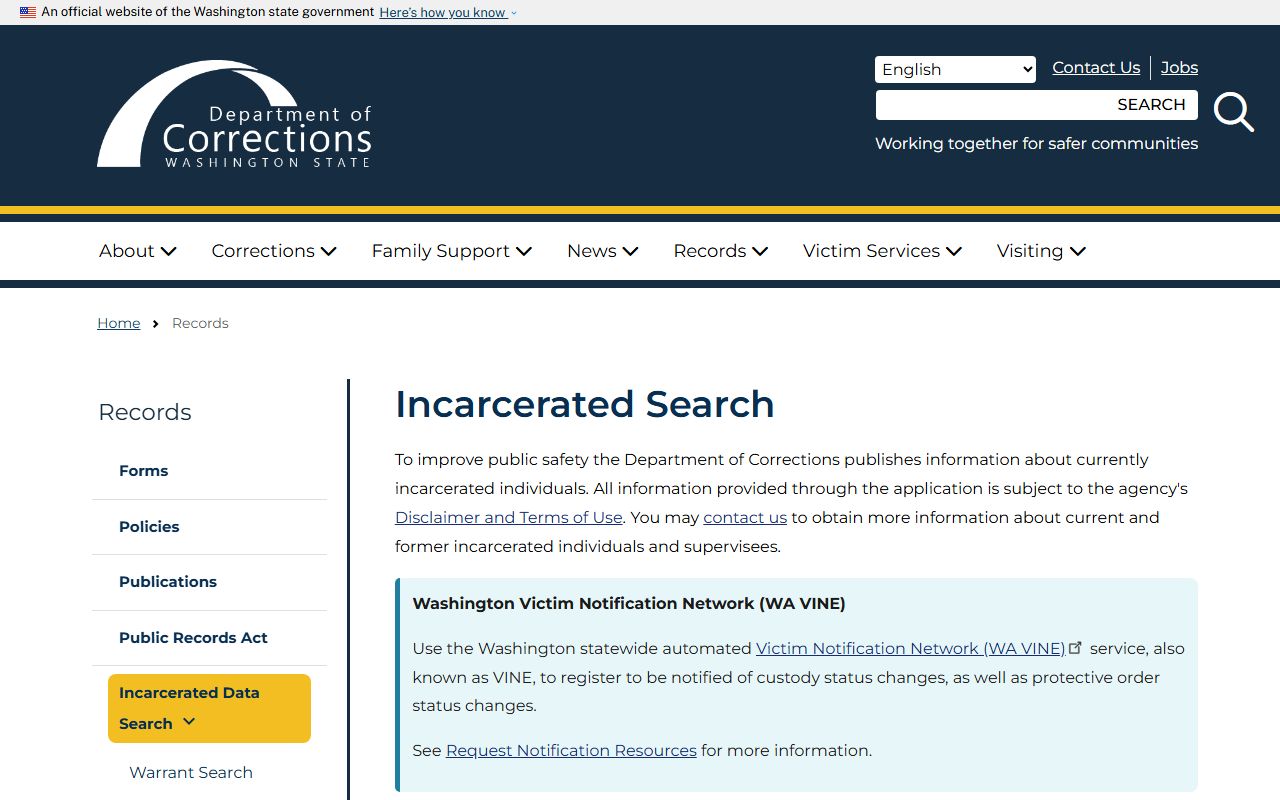
The form is aimed at state corrections records, so it should not be treated as a universal arrest search for every Washington jail.
| Search Field | Best Use | Limit |
|---|---|---|
| DOC Number | Most precise state prison identifier | Does not match county booking, BOP, ICE, or court numbers |
| First Name | Useful with last name when the DOC number is unknown | Spelling and aliases can affect results |
| Last Name | Broad name lookup for people in DOC custody | Common names may require careful result review |
| WA VINE link | Custody notification after locating a person | Notification tool, not a full court-record portal |
DOC Prisons and Custody Levels
DOC says Washington has 10 prison facilities with custody levels from minimum to maximum. The current prison list includes Airway Heights Corrections Center, Cedar Creek Corrections Center, Clallam Bay Corrections Center, Coyote Ridge Corrections Center, Monroe Correctional Complex, Olympic Corrections Center, Stafford Creek Corrections Center, Washington Corrections Center, Washington Corrections Center for Women, and Washington State Penitentiary. Reentry centers and partial confinement are related DOC custody paths, but they are not county jails.
DOC classification is based on a Custody Review Score. The agency says the score considers current custody level, infractions, program behavior, detainers, and escape history. DOC definitions identify Level 5 Maximum, Level 4 Close, Level 3 Medium, Level 2 Minimum, and Level 1 Community Based or Partial Confinement. These labels should not be confused with local jail housing or classification terms.
The DOC prison facilities page shows the state prison count and the age table behind the headline DOC inmate population figure.
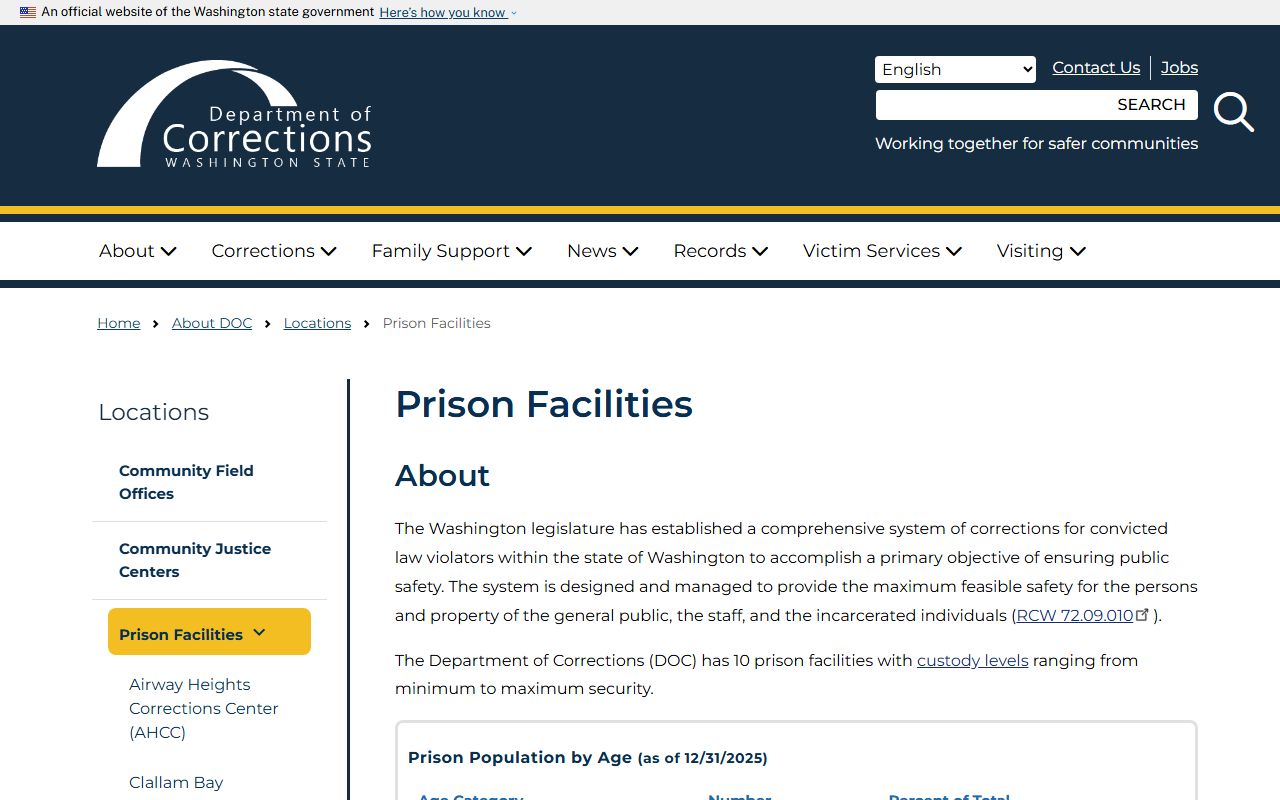
The same agency source is the proper anchor for statewide prison population statements because county rosters cover only local jail custody.
| DOC Prison | County Area | January 2026 ADP / Capacity in DOC report |
|---|---|---|
| Airway Heights Corrections Center | Spokane County | 1,836 / 2,148 |
| Coyote Ridge Corrections Center | Franklin County | 1,958 / 2,531 |
| Monroe Correctional Complex | Snohomish County | 1,514 / 1,624 |
| Washington Corrections Center | Mason County | 1,629 / 1,742 |
| Washington State Penitentiary | Walla Walla County | 2,209 / 2,356 |
Note: DOC's current prison list has 10 facilities; Mission Creek appears in some ADP tables but is not in DOC's current active prison overview.
DOC Inmate Population Trend
The DOC inmate population trend in the research is stable to modestly up, not a sudden spike. DOC's forecast comparison report listed a Prison and Work Release Population of 13,772 in January 2025 and 13,945 in January 2026. Late 2025 monthly figures were near 14,000, with 14,026 in November and 14,012 in December. The January 2026 figure was 173 higher than January 2025.
The facility ADP report gives a second view. In January 2026, Prison Facility Totals were 13,050 against capacity of 14,736. The broader prison total confinement plus partial confinement line was 13,999 against capacity of 18,102. These two lines answer different questions: one is prison-facility custody; the other includes partial confinement connected to DOC custody.
| Month | Prison and Work Release Population | Source Context |
|---|---|---|
| January 2025 | 13,772 | DOC forecast comparison report |
| June 2025 | 13,948 | Mid-year point in same series |
| November 2025 | 14,026 | Highest listed late-2025 month in research summary |
| January 2026 | 13,945 | Net increase of 173 from January 2025 |
DOC Release and Earned Time
Washington felony sentencing is mainly determinate, but DOC release dates still depend on court-filed documents, jail credits, earned release time, and special statutory categories. RCW 70.48.400 is the research anchor for the jail and DOC placement divide. County jails handle pretrial custody and local jail sentences, while prison custody is for people committed to DOC, often for sentences over one year.
Earned release time is the state's good-time concept for DOC confinement. RCW 9.94A.729 allows eligible sentence reduction through earned release time under correctional-agency procedures. DOC's sentencing FAQ describes a basic calculation path: start with the total sentence, subtract jail credits and jail good-time credits, then apply the DOC earned-time percentage that fits the offense and law. The FAQ lists percentages of 0%, 10%, 15%, or 33 1/3% depending on the case.
Release-date caution: DOC says Records staff act on court-filed documents with clerk stamps and signatures, so court paperwork can affect release timing.
Parole in the broad old sense is limited. The Indeterminate Sentence Review Board remains important for covered pre-SRA cases, certain indeterminate sex-offense sentences, and other board-jurisdiction cases. DOC describes ISRB as a quasi-judicial release board that weighs behavior and public-safety risk.
DOC Public Records Requests
DOC public records follow a written request route. The DOC Public Records Request page says requests must be submitted to the DOC Public Records Officer and that a Public Records Coordinator responds within five business days. The page cites RCW 42.56.580 for the public-records officer role and RCW 42.56.520 for response timing. A request should include the requester's contact information, the date, and the records sought.
DOC records requests are not the right first route for a county jail booking entry, a city jail roster record, a BOP record, an ICE detainee entry, or a Washington Courts case file. Use DOC for state prison records and DOC publications. Use the jail that created the booking record for jail files. Use the court of record for filed charges, pleadings, calendars, judgments, and docket documents.
The DOC public records page identifies the written request channel for state corrections records.
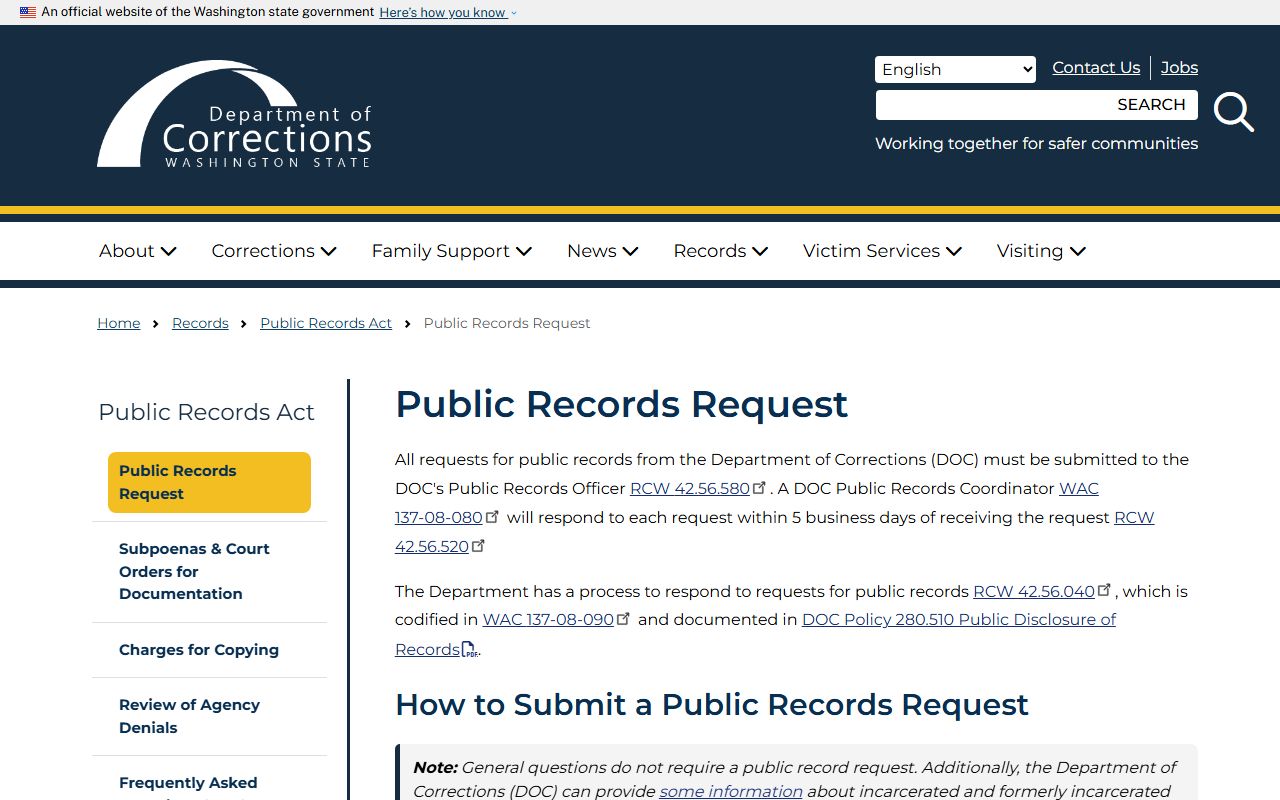
That route is separate from Washington's county jail roster pages, which are maintained by the local facility or sheriff's office.
DOC, BOP, ICE, and VINE
The DOC inmate locator covers Washington state corrections custody. Federal custody uses the Federal Bureau of Prisons locator, which covers federal inmates from 1982 to the present. Immigration detention uses ICE Online Detainee Locator System, searched by A-number or biographical data. Washington custody notifications use WA VINE through VINELink.
WA VINE is a notification tool, not a court case portal. WASPC says WA VINE provides custody-status information and automated custody notifications, but it does not provide court or case information and does not provide sex-offender notifications. Washington Courts remains the statewide path for municipal, district, superior, and appellate case search.
The Washington VINELink portal is the statewide custody-notification channel tied to WA VINE.
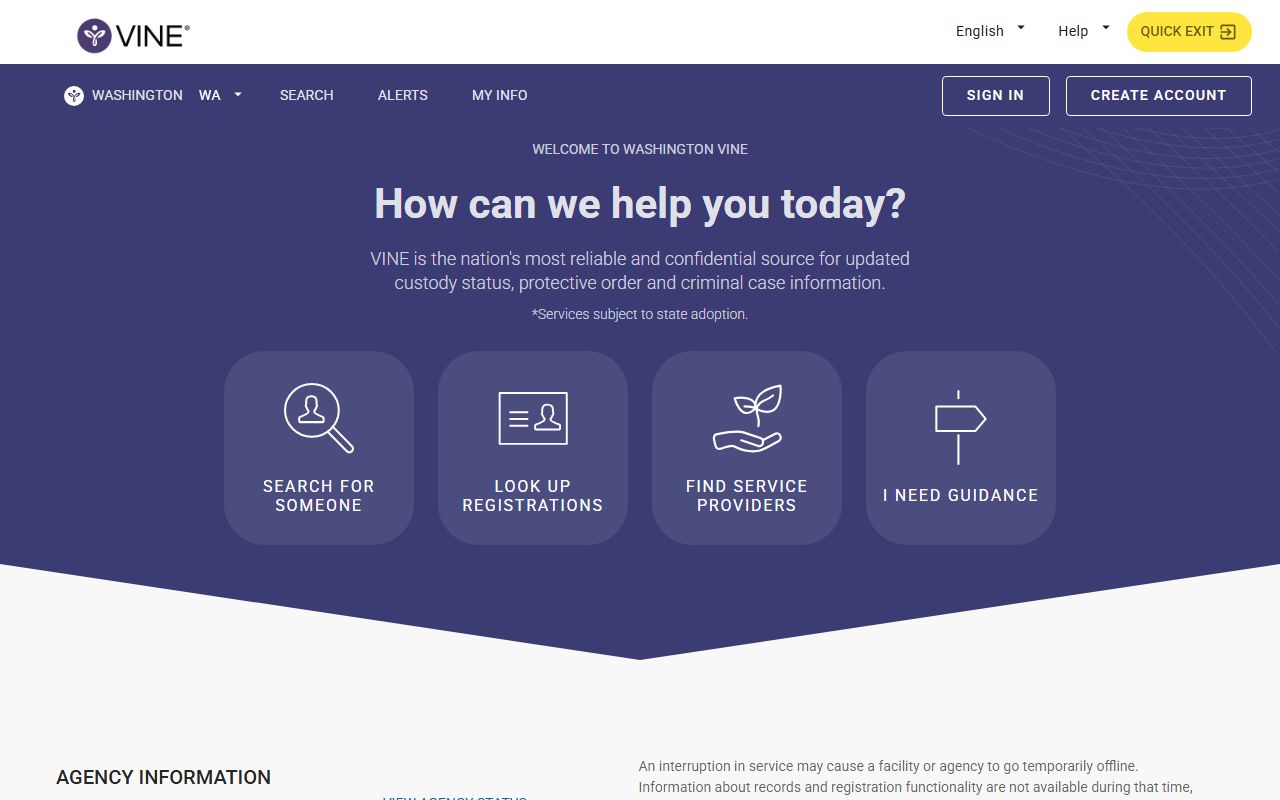
Use it after identifying the right custody system, especially when release or transfer notification is the goal.
When DOC Search Is Wrong
DOC inmate population search is often the wrong tool for the first few days after an arrest. County and city jails control local booking records, bail status, housing, local release, and jail-register entries. Washington Courts controls filed case information after a prosecutor opens or updates a case. A DOC record becomes the better source when the person has been committed to state custody, received by a prison, placed in a DOC reentry center, or moved into another DOC incarcerated location.
Washington law also limits what a public roster can show. RCW 70.48.100 makes the jail register public, but it also treats many records of a confined person as confidential unless a statutory release applies. That is why the public may see name, booking, confinement cause, discharge, charge, bail, or status fields in one local roster while full inmate files, juvenile material, medical records, and some booking-photo details stay restricted. DOC search has its own disclaimer and selected public fields, so a missing field is not proof that no record exists.
| Situation | Best Starting Point | Reason |
|---|---|---|
| Fresh county arrest | County or city jail roster | The booking agency owns the local jail record |
| Sentenced state prison term | DOC Incarcerated Search | DOC manages state prison and reentry custody |
| Charge status after first appearance | Washington Courts case search | The court record tracks filed charges and hearings |
| Federal sentence or detention | BOP Inmate Locator | Federal custody is outside Washington DOC |
Public Record Search
Sponsored Results